9 SEO Strategies for Water Damage Restoration Companies in 2026
Get Your Free SEO Audit Today!
SEO for water damage means four things working together. Damage-type-specific service pages, a fully built Google Business Profile, fixed technical issues, and real backlinks. Skip one and the rest struggle to rank. Water damage restoration SEO carries more weight than most home service industries. Emergency searches convert fast, and the company that shows up first usually gets the call.
Most restoration companies still bundle every service onto one generic page. That single habit is the biggest ranking mistake in this industry. This guide breaks down nine strategies that fix it, one at a time. Most owners already sense something is off. Calls dip, then a competitor shows up first on Google. Fixing that starts with understanding what actually moves rankings in this industry.
1. Research Water Damage Keywords by Search Intent
Water damage keywords split into two clear buckets. Emergency searches, like 24-hour water damage restoration near me. Research searches, like how to dry a flooded basement. These are not the same ranking competition. Google treats them as separate queries with separate results pages. A page built for one rarely ranks for the other.
Trying to optimize a single page for both usually means it ranks for neither. Start with a simple spreadsheet, not expensive software. List each damage type down one column. List intent tier next to it, emergency or research.
Match every keyword to exactly one target page. If a query has no page built for it yet, that is a gap. That gap is lost revenue sitting in plain sight. Revisit this list every quarter, since search behavior shifts with seasons and news events. Storm season brings a wave of new emergency phrasing worth capturing early.
- Emergency keywords: 24-hour water damage restoration, emergency flood cleanup near me, burst pipe repair today
- Research keywords: how to dry a flooded basement, signs of hidden water damage, water damage insurance claim steps
- Local modifiers: your city name, nearby neighborhoods, and county terms added to core service phrases
SEO for water damage depends on getting this split right early. Near me and 24-hour modifiers carry outsized weight here. A panicked homeowner adds urgency words a normal searcher never would. Map that urgency language before writing a single page. It shapes which pages you build first and how you title them. Pull a handful of competitor pages ranking for these terms too. Note which questions they answer and which ones they skip entirely. Those gaps are often the easiest pages to build first.
2. Build a Dedicated Page for Every Damage Type
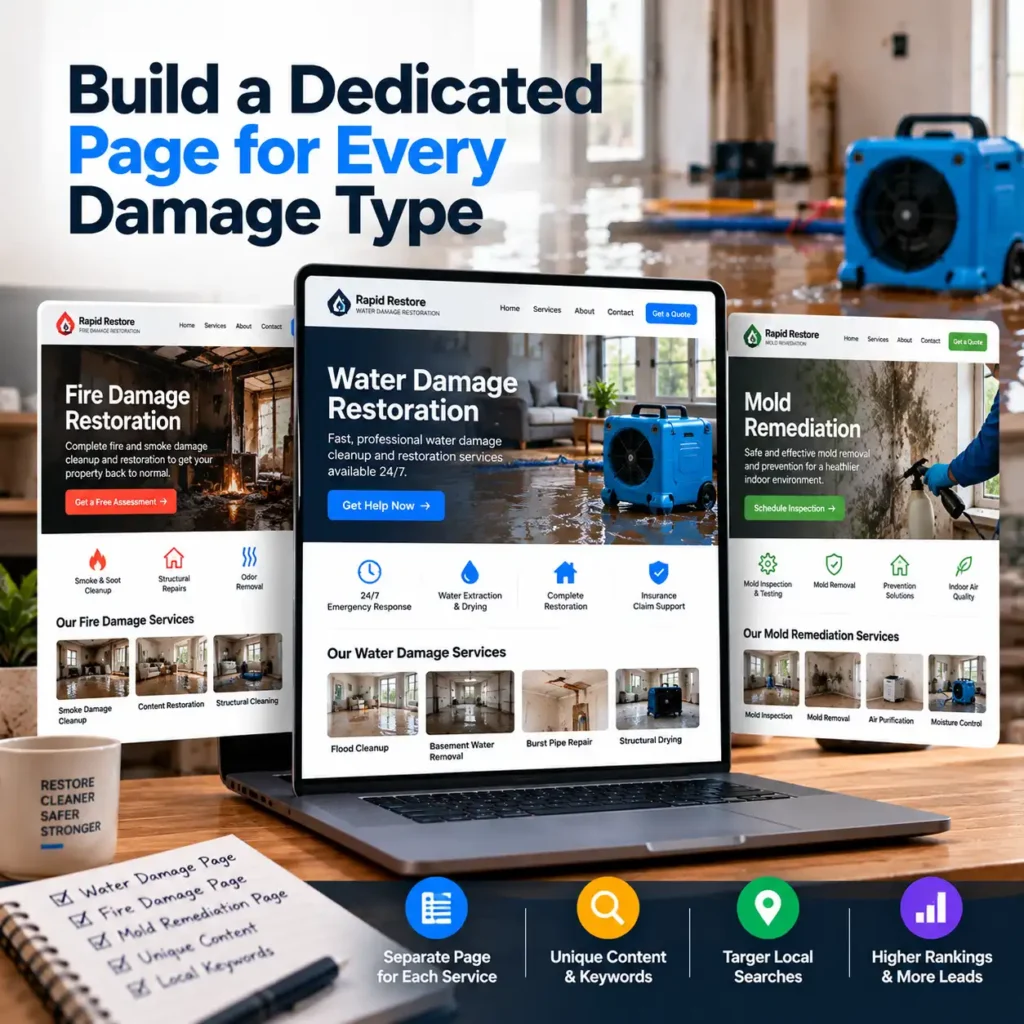
Every top-ranking competitor agrees on one point. A bundled restoration services page competes for nothing specific. Google treats water damage, fire damage, and mold as separate topics. Each one carries its own local search intent. A water damage restoration company needs a dedicated page for each service. Not a paragraph on a shared page.
A full standalone page with its own URL, title tag, and H1. A generic page also confuses Google about your core expertise. Search engines reward sites that clearly specialize, not ones that mention everything briefly. Depth on one topic beats a shallow mention of five.
- Water damage restoration, as its own page with a clear URL
- Fire damage restoration, built separately with its own title tag
- Mold remediation, targeting its own local search intent
- Biohazard or contents cleanup, if you offer it as a service
Each core service page needs real depth to compete. Aim for 1,200 to 2,000 words of substantive content. Cover your process step by step, from extraction to drying. Explain insurance claim procedures, since homeowners search for this directly. List certifications and show real before-and-after photos from actual jobs.
Place a clear call to action above the fold and again at the bottom. Update these pages every few months, even with small changes. Stale pages with no recent edits can quietly lose ranking over time. A fresh photo or an updated stat signals the page is actively maintained.
3. Create City-Specific Local Landing Pages
City-specific pages follow a simple formula. Damage type, plus restoration, plus city name. Water damage restoration Dallas is one example. Mold remediation Austin is another. Swapping only the city into a template produces thin content. Google recognizes that pattern and it rarely ranks. Real local SEO here means real local detail on every page. Prioritize your highest-revenue cities first if time is limited.
Building all fifteen pages at once rarely happens for a small team. Two or three well-built pages beat ten rushed ones every time.
- Name the specific neighborhoods you serve in that city
- Mention damage causes common to that area, like flash flooding or aging pipes
- Include a documented response time from that location
- State the insurance carriers you commonly work with there
Internal linking ties this structure together. Each city page links back to its matching core service page. The core water damage page links out to every city version. This builds a topical cluster Google can map clearly. Water damage restoration SEO works best when every page reinforces the others. Isolated pages with no connection rarely perform as well.
Add a short map or service radius on each page too. This gives both visitors and Google a clear picture of your coverage area. That builds trust before the first call even happens. That local detail separates a page that ranks from one that never will.
4. Optimize Your Google Business Profile for the Map Pack
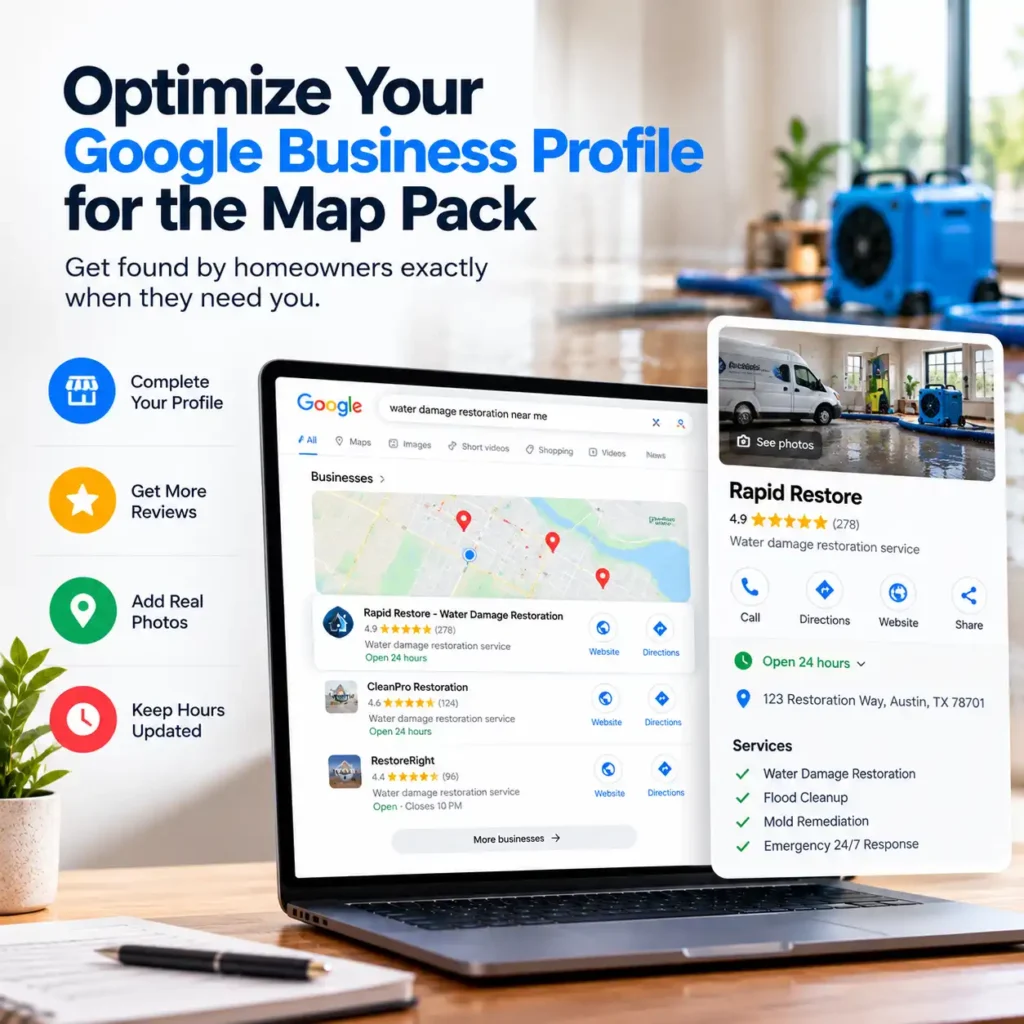
Your Google Business Profile drives most local visibility for this industry. Set the primary category to Water Damage Restoration Service. Add Fire Damage Restoration and Mold Remediation as secondary categories. Write a description that names your city in the first two sentences. Weave in your top services naturally, without cramming keywords.
List your full service area, down to specific neighborhoods if possible. An incomplete profile reads to Google like a business that barely exists. Verify the profile directly through Google first, since unverified listings rank far behind verified ones. Enable messaging so people can reach you straight from the profile itself. Every extra way to make contact is one more chance to win that call.
- Correct primary category, not a generic cleaning label
- Secondary categories for every damage type you handle
- Keyword-rich description naming your city early
- Complete service area listed down to the neighborhood level
Treat the profile as a living channel, not a one-time setup. Upload real job photos every week, not once a quarter. Post to Google Posts weekly, since weekly posting drives meaningfully more calls than monthly posting. Review velocity matters too, not just the total count. Five new reviews a month, sustained over time, works better.
Fifty reviews in one week followed by silence does not. Keep your business hours accurate at all times, especially around holidays. An outdated hours listing frustrates a homeowner during an actual emergency. That frustration rarely turns into a call. Respond to every review within a couple of days, positive or negative. A thoughtful reply to a negative review builds real trust. It often does more than a dozen unanswered five-star reviews.
5. Strengthen On-Page SEO Signals
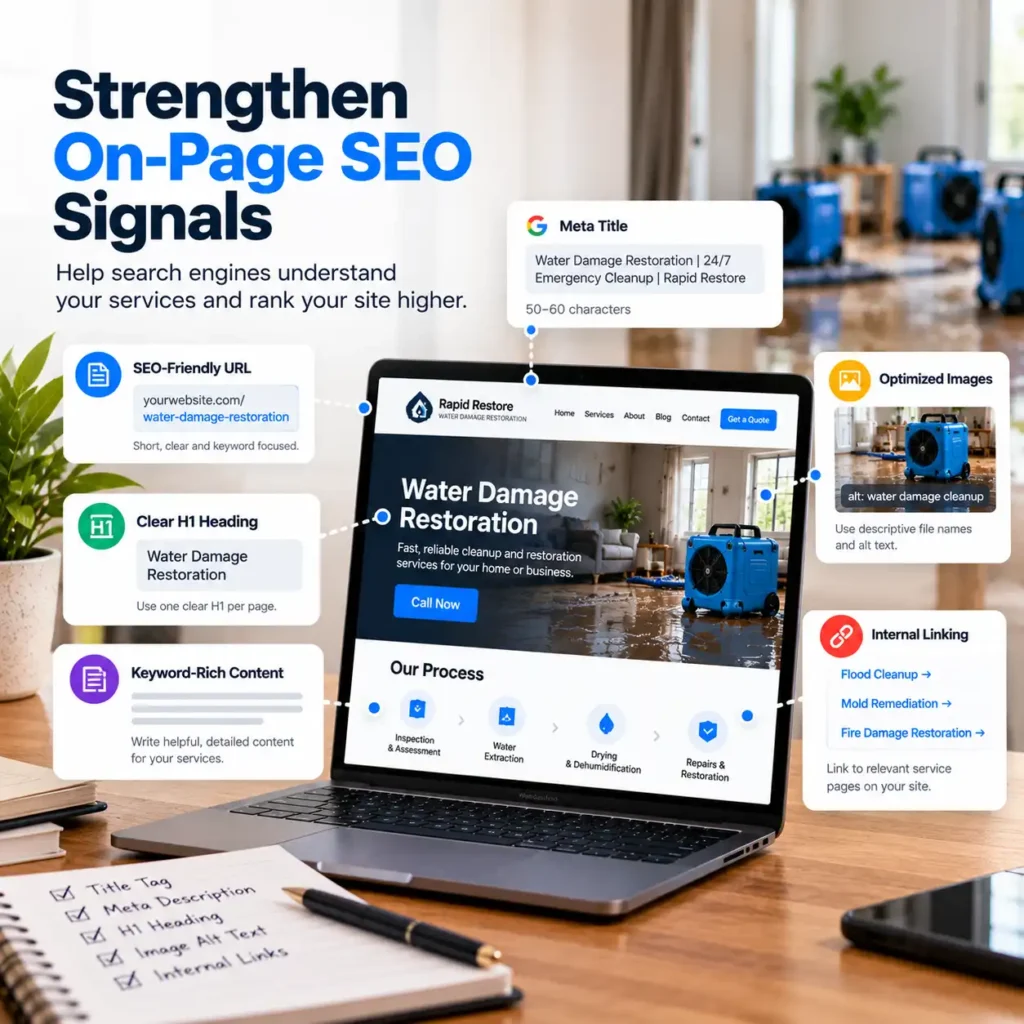
On-page signals tell Google exactly what each page covers. Write a unique title tag and meta description for every page. Name both the damage type and the city in each one. Structure your headings clearly: one H1, several H2s, supporting H3s underneath. This helps Google parse the page and helps a skimming visitor find their answer fast.
A visitor should understand the whole page from headings alone. No paragraph reading required for that first impression. Avoid duplicate title tags across similar pages, even when the wording feels repetitive to write. Each page needs its own distinct signal. This holds even when two pages cover closely related services in the same city.
- Target keyword in the title tag, H1, and first 100 words
- Descriptive alt text on before-and-after photos, not generic file names
- Meta descriptions under 160 characters naming damage type and city
- Clean, hyphenated URLs instead of long strings with random numbers
A water damage restoration website built this way sends clear signals throughout. Place your keyword naturally in the opening paragraph, then let it go. Repeating it every few sentences reads as stuffing to both Google and real visitors. SEO for water damage restoration companies works best when pages read naturally. Write for a person first, search engines second. Internal links matter here too, more than most owners realize.
Link from each service page to its related city pages naturally. Link from blog posts back to the service page they support. These connections tell Google how your site fits together. It reads as one coherent whole, not scattered pages. Run a quick audit every few months using a free crawling tool. Look for missing titles, duplicate meta descriptions, and broken links. Catching these early keeps small technical issues from quietly piling up over time.
6. Publish Content That Builds Authority Before the Emergency
Blog content builds trust before the emergency even happens. A homeowner with a small leak or a musty smell searches first, before hiring anyone. That search is your chance to be the helpful answer, not a sales pitch. This works through pillar and cluster structure. One pillar page per core service, with supporting blog posts linking back to it. Think about what that homeowner actually needs at that exact moment.
Not a sales pitch, not a wall of company history. A clear, direct answer to the specific question they typed in. Answer it well and they remember your name later. That memory matters when the small leak becomes a real emergency.
- Prevention checklists, like signs of hidden mold in walls
- How long does X take: explainers for common services
- Common mistakes homeowners make during early cleanup
- Insurance claim guides specific to water and fire damage
This content does more than build trust slowly over time. Water damage restoration SEO in 2026 also means feeding Google’s AI Overviews. Clear, well-structured answers get pulled into those summaries directly. That puts your name in front of searchers before they even click a result. Content built for humans first tends to win both places at once. Pull real questions from past customers if you have them on file. Front desk staff and technicians usually know exactly what people ask before hiring.
That real-world list beats a generic topic brainstorm most of the time. Update older posts periodically instead of only publishing new ones. Refreshing a post with current numbers or a new photo helps. It often lifts ranking faster than starting a brand new page from scratch.
7. Fix Technical SEO and Site Speed Issues
Site speed is a revenue issue here, not just a ranking one. The average restoration website takes close to ten seconds to load its main content. Google’s own threshold sits at 2.5 seconds. That gap costs real leads, not just search position.
A homeowner mid-emergency on a phone will not wait around for a slow page. Run your site through a free speed testing tool this week. Note the load time on mobile specifically, not just desktop. Most owners are surprised by how slow their site actually loads. That surprise usually explains a chunk of missing calls nobody had connected to speed before.
- Compress images before uploading, since oversized files are the top cause of slow loads
- Minify CSS and JavaScript to cut unnecessary code weight
- Enable browser caching so repeat visitors load pages faster
- Keep a tappable phone number visible above the fold on every page
Most restoration searches happen on mobile, often mid-crisis. That raises the stakes on this section compared to other home service trades. A slow-loading water damage restoration website loses the call fast. The visitor leaves before they even see your services. Test your site on a slow connection, not your office WiFi, before trusting the numbers.
Responsive design matters as much as raw speed here. The layout should adjust cleanly to any screen size automatically. A visitor should never need to pinch or scroll sideways to read your services. Choose a reliable hosting provider too. Server response time matters as much as anything on the page itself.
8. Add Schema Markup for Water Damage Services
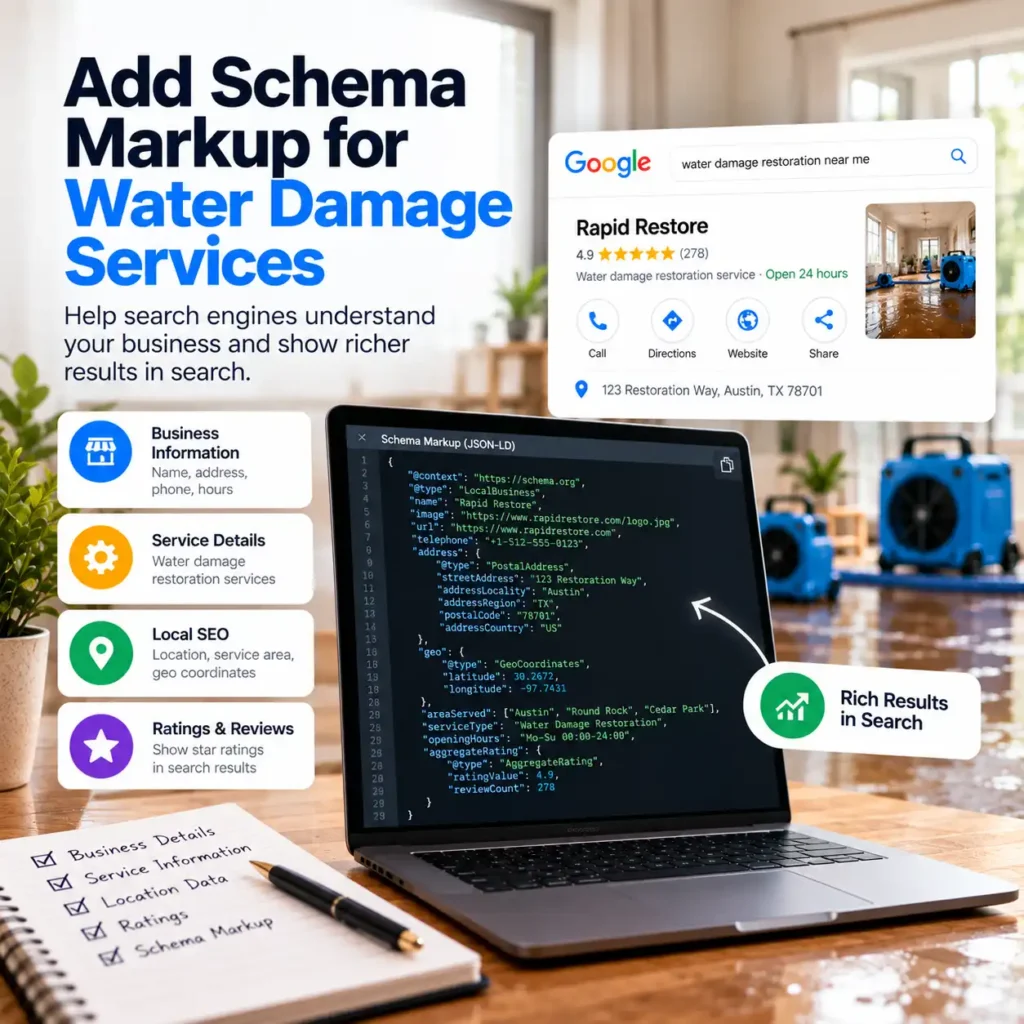
Schema markup remains the most overlooked technical fix in this industry. Only a small share of restoration companies use structured data at all. That share sits well below the average across other business types. That gap is a real opportunity, not a minor detail. Add LocalBusiness schema to your homepage so Google understands your core business identity. Add Service schema to each service page and FAQPage schema to your FAQ blocks. Review and AggregateRating schema can display your star rating directly in search results.
This is a rare case where a small technical fix outpaces months of content work. Schema does not change what a visitor sees on the page itself. It changes what Google understands about that page behind the scenes. That understanding shapes whether your business shows up in rich results at all. Implementation itself does not take long once you know what to add.
A developer can typically wire up the core schema types in half a day. The payoff compounds for years afterward with almost no ongoing maintenance required. Use a free validator tool to confirm the markup is readable by search engines.
- LocalBusiness schema on your homepage, with name, address, and hours
- Service schema on each service page
- FAQPage schema wrapped around your FAQ content
- Review or AggregateRating schema to surface star ratings in results
9. Build Local Citations and Restoration-Specific Backlinks
Local SEO depends heavily on citations that Google can trust. Your business name, address, and phone number need to match everywhere online. List your water damage restoration company on Yelp, Angi, and the BBB. Add the IICRC contractor finder too. A single wrong suite number across one directory can quietly suppress your local rankings.Guest posts and link insertions on relevant sites add real authority too. Start with the big three: Yelp, Angi, and the Better Business Bureau. Add the IICRC contractor finder next, since it carries real industry weight. Keep a simple spreadsheet tracking where you are listed and with what exact details. Consistency across all of them matters more than the total number of listings.- Consistent NAP across every directory and listing
- Industry-specific directories like the IICRC contractor finder
- Guest posts on local home improvement or news sites
- Digital PR pitched around real storm events in your area
15 Backlink Websites
| # | Website | Approx. DA |
| 1 | Better Business Bureau (BBB) | 78 |
| 2 | Yelp for Business | 100 |
| 3 | Angi (Angie’s List) | 65 |
| 4 | Thumbtack | 68 |
| 5 | Nextdoor Business | 74 |
| 6 | IICRC Certified Firm Locator | 44 |
| 7 | RIA (Restoration Industry Association) Directory | 39 |
| 8 | HomeStars | 52 |
| 9 | Manta.com | 49 |
| 10 | Local home improvement blog | 35-50 |
| 11 | Blogger | 72 |
| 12 | Medium | 97 |
| 13 | Patrion | 81 |
| 14 | HomeAdvisor / Angi Leads | 80-85 |
| 15 | Tumblr | 86 |
Let Codestro Build Your Water Damage Restoration SEO
Most restoration companies right now lean on paid ads, lead brokers, or referrals. All three work fine until you stop paying or stop asking. The moment ad spend gets cut, the calls stop coming with it. That is not a growth strategy. It is a treadmill that never actually moves you forward. That treadmill gets more expensive every year too. Ad costs in this category keep climbing every year. Every dollar spent stops producing the instant you stop spending it.
Codestro builds the organic version instead: an SEO team that understands water damage restoration. Here is what that system actually covers:
- Keyword research split by emergency and research-stage intent
- Dedicated service pages for every damage type you handle
- City-specific location pages with real local detail
- A fully optimized Google Business Profile, updated weekly
- On-page SEO and technical fixes that keep your site fast
- Schema markup and local citations that build lasting authority
Ready for consistent organic water damage leads?
Book a free strategy call on Codestro’s Calendly, or reach out directly at info@codestro.com.
Key Takeaways
- Keyword research splits emergency searches from research-stage ones.
- Dedicated service pages outrank one bundled page every time.
- City-specific pages need real local detail, not a swapped name.
- Google Business Profile drives most of your local visibility.
- On-page signals tell Google exactly what each page covers.
- Blog content builds trust before the emergency even happens.
- Site speed decides whether a mobile visitor waits or leaves.
- Schema markup remains the most overlooked technical fix.
- Citations and backlinks prove your business is real and local.





With increasing digital competition across the United States businesses in Washington DC, now realize that their websites need to accomplish more than just existing. Websites today need to perform, engage,
In the age of digital-first consumption, your website is an extension of your business. Whether you are a startup, small to mid-sized business, or a growing enterprise, your website can
In the fast-paced world of the cyber economy today, your website is more than just an online address — it is your most effective sales tool. Whether you are a
In today's "digital first" economy, having a website is no longer just a "nice-to-have "... it is a must-have for generating sales, establishing credibility, and growing your business! Your website
In a digitized world, your website is more than a digital business card - it is the core of your brand identity, customer engagement, and company growth. For Birmingham businesses,
Choose Your Growth Plan
Local Starter
$499/mo
- 1 City Targeting
- Google Business Profile Optimization
- 5 Citation Listings
- Monthly SEO Report
- Basic Local SEO Setup
Growth
$899/mo
- 1 City Targeting
- Google Business Profile Optimization
- 5 Citation Listings
- Monthly SEO Report
- Basic Local SEO Setup
Domination
$1,499/mo
- 1 City Targeting
- Google Business Profile Optimization
- 5 Citation Listings
- Monthly SEO Report
- Basic Local SEO Setup
Frequently Asked Questions
Most restoration companies see meaningful ranking movement within three to six months. A dominant share of leads coming from organic search usually takes closer to twelve months. Do not expect major call volume before month three. Keep another channel running until rankings stabilize. Competitive metros can push that timeline out further. Solid Map Pack movement can take closer to six months there.
Handle it in-house if you can commit several hours a week to it consistently. Hire an agency if your site has real technical debt. The same goes if you serve five or more cities. That volume of location pages is hard to produce well while running a restoration business.
Bundling every service onto one generic page instead of building separate ones. Google treats water damage, fire damage, and mold as distinct topics with distinct intent. A single bundled page simply competes for nothing specific. The second most common failure is unresolved technical issues, especially slow load times on mobile.
Yes, local SEO matters almost entirely here. Your customers search within your city, county, and service area. Put your energy into local rankings, a complete Google Business Profile, and city-specific pages. National visibility means little if you only serve one region.
Most credible engagements run a few thousand dollars a month, depending on market competition. Paid ads in this category often run over a hundred dollars per click. SEO becomes the lower-cost channel at scale. It just takes months of investment before it becomes the dominant lead source.