
9 SEO Tips to Fill More Beds at Your Care Home
Get Your Free Consultation Today!
SEO for care homes works when your site shows up the moment a family searches, not months after. That timing gap is where most operators lose beds. A family runs a search tonight. A competitor three miles away ranks first for that exact phrase, and the phone rings there instead of here.
Nine tips follow, ordered roughly fastest to slowest payoff. Some move the needle in weeks. Others take a season to show up. You do not need all nine running at once. Pick three, do them properly, then add the next.
What SEO for Care Homes Actually Means
SEO here is not chasing generic keywords. It means showing up for one specific family typing one specific care type plus their ZIP code. Usually from a phone. Usually during a moment that feels urgent. A dad fell last week, and someone needs an answer by Friday.
That is different from paid ads, and the distinction matters. SEO is slower to start. But it keeps working after you stop actively promoting it. Paid ads stop the moment you stop paying for them. One channel rents attention. The other builds something that stays.
Why Care Homes SEO Matters More Than Most Operators Think
Most families research online before they ever call a provider. Pew Research has tracked this pattern in health-related searches for years, and senior care fits the same behavior. Nobody opens the phone book anymore. They open Google.
Local visibility carries extra weight in this industry, because families rarely move a parent across the country. They search within a tight radius, so map pack placement matters more here than for most local businesses. And the fear attached to each search differs by care type. Someone Googling memory care is scared about cognitive decline. Someone searching independent living just wants options. Your content needs to speak to whichever fear brought that person to the search bar.
How Long Care Homes SEO Actually Takes
Nobody wants to hear this, but honesty beats a false promise. SEO does not move overnight, and treating it that way sets up disappointment by month two.
Realistic timeline:
- Ranking movement: 8 to 12 weeks for early signals
- Inquiry increases: 3 to 6 months for most communities
- Competitive markets: 6 to 12 months before it fully compounds
Compare that wait against the cost of one empty bed for those same months. The math usually favors starting now, not waiting for a faster fix that doesn’t exist.
9 SEO Tips to Fill More Beds at Your Care Home
These are ordered by speed of payoff, not by importance. Start with the fastest three below before moving down the list.
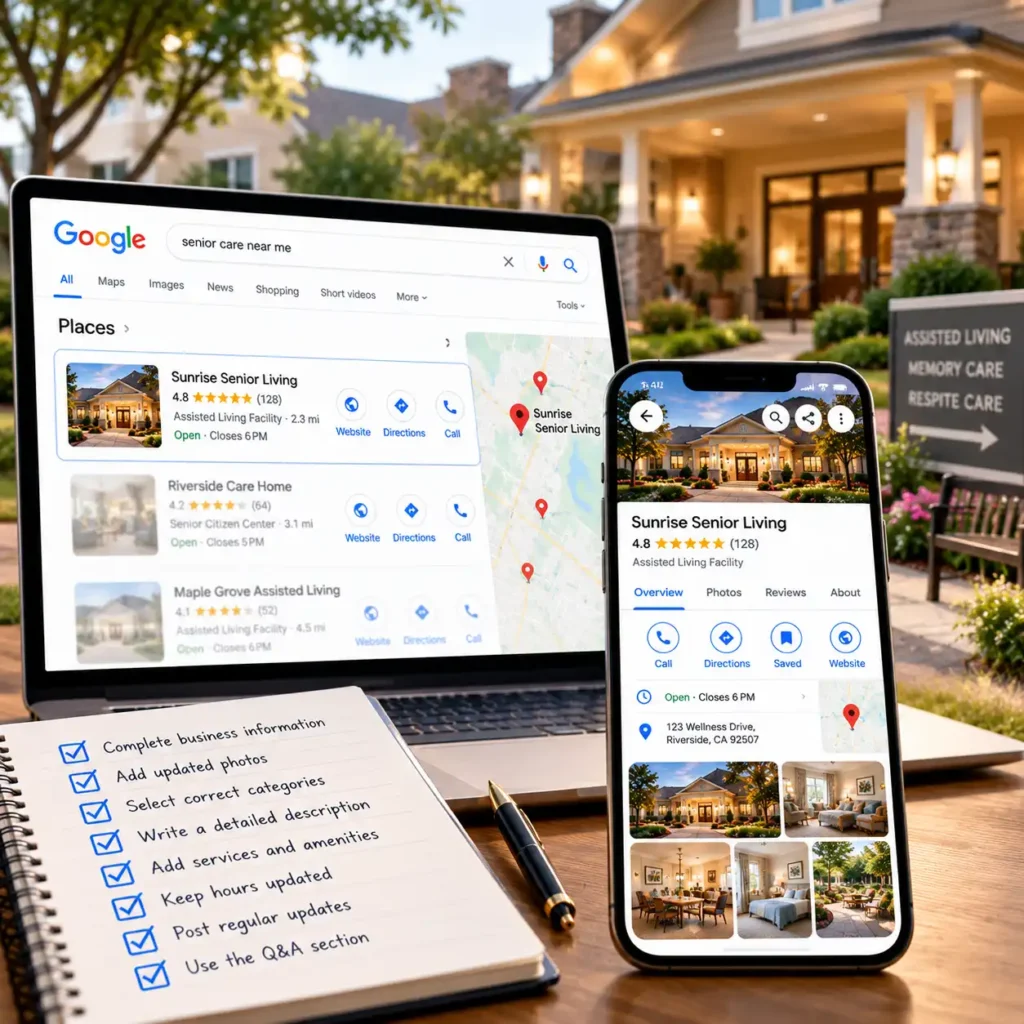
1. Claim and Fully Build Out Your Google Business Profile
This is tip one for a reason. It moves fastest, and it costs nothing. The map pack takes most local clicks, and the top three spots grab almost all of them. Ranking fifth barely matters at all.
“Fully built out” means specifics, not a checkbox. List every care type by name instead of one vague category like senior care. Upload real photos from this year, not a stock lobby shot nobody recognizes. Keep hours accurate, including weekend tour slots families actually need.
Fix these first:
- List every specific care type you offer, not one broad category
- Upload current photos of rooms, dining areas, and common spaces
- Keep hours accurate, including weekend tour availability
- Fill out the Q&A section most competitors ignore
- Post updates monthly so the profile shows active management
One limitation worth naming. A flawless profile with zero reviews still underperforms. That brings us to tip two.
2. Build a Review Pipeline That Doesn’t Look Staged
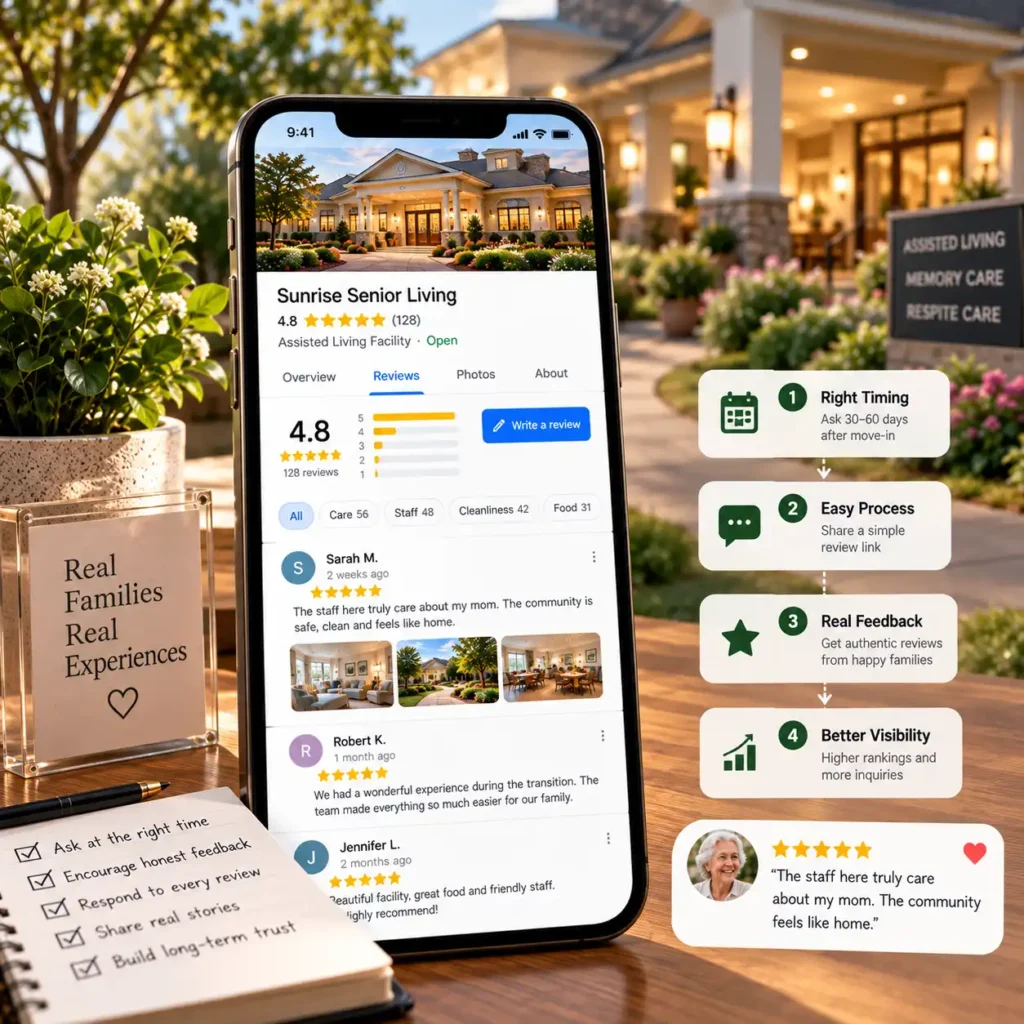
Reviews shape both rankings and the family’s actual decision. And families read closely enough to spot a copy-pasted reply from a mile away.
Timing trips up most operators. Asking on move-in day feels rushed, because it is. A cluster of five reviews posted the same week looks manufactured to anyone paying attention. Wait 30 to 60 days instead, once the family has watched their parent settle in and eat well again.
Build the habit right:
- Ask 30 to 60 days after a positive move-in, not day one
- Space requests out instead of batching them
- Reply to every review individually, no copy-paste templates
- Respond to negative reviews calmly and specifically, never defensively
A real, specific reply to a hard review builds more trust than another five-star post ever will.
3. Keep Your Name, Address, and Phone Number Identical Everywhere
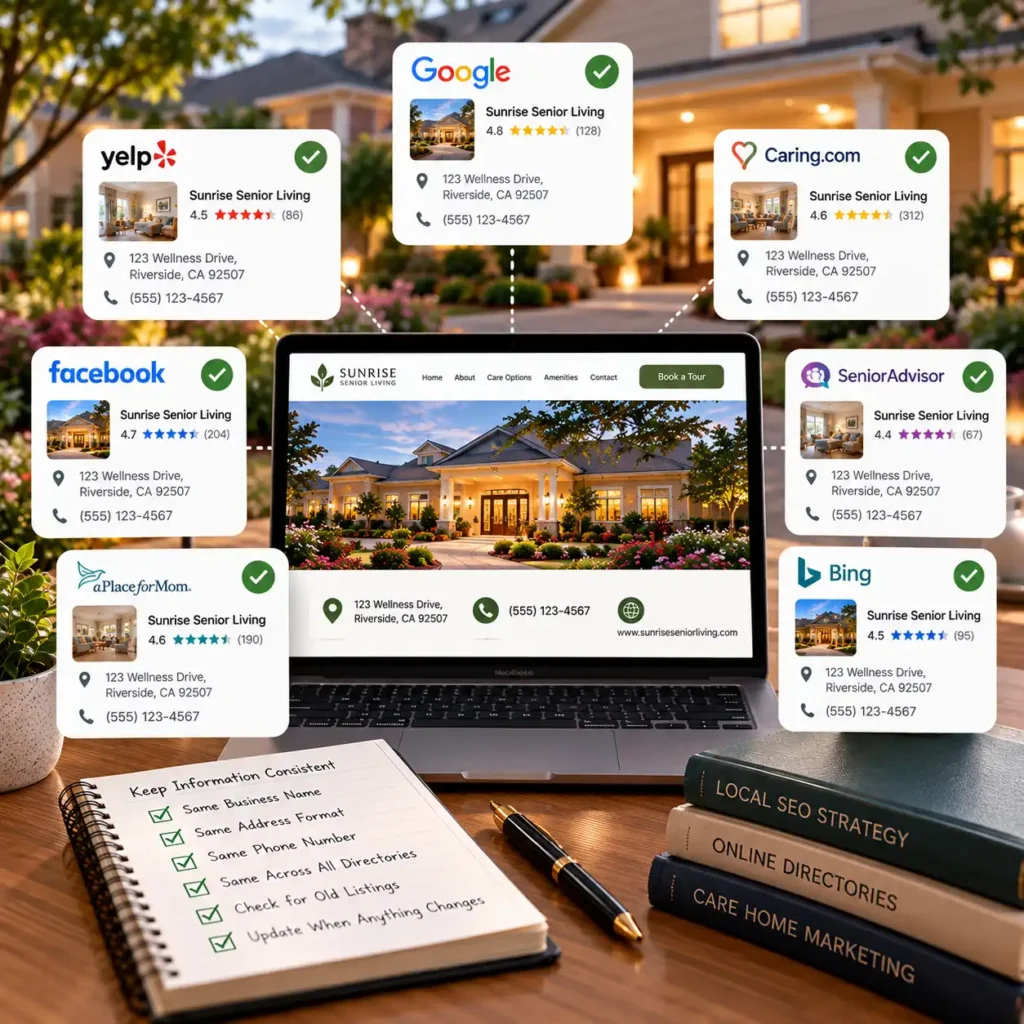
NAP consistency sounds technical, but it’s simple. Your care home’s name, address, and phone number need to match exactly across your site, Google, Caring.com, SeniorAdvisor, and Yelp. Even “Ave” versus “Avenue” quietly confuses search engines about whether these listings belong to the same place.
Run this audit:
- Check listings on Google, Yelp, Caring.com, and SeniorAdvisor
- Match formatting exactly: abbreviations, suite numbers, punctuation
- Fix old listings tied to a previous address or owner
- Recheck every 6 months, since directories drift on their own
Senior care directories multiply fast, and stale listings from years ago rarely clean themselves up. This is unglamorous work. It still moves rankings.
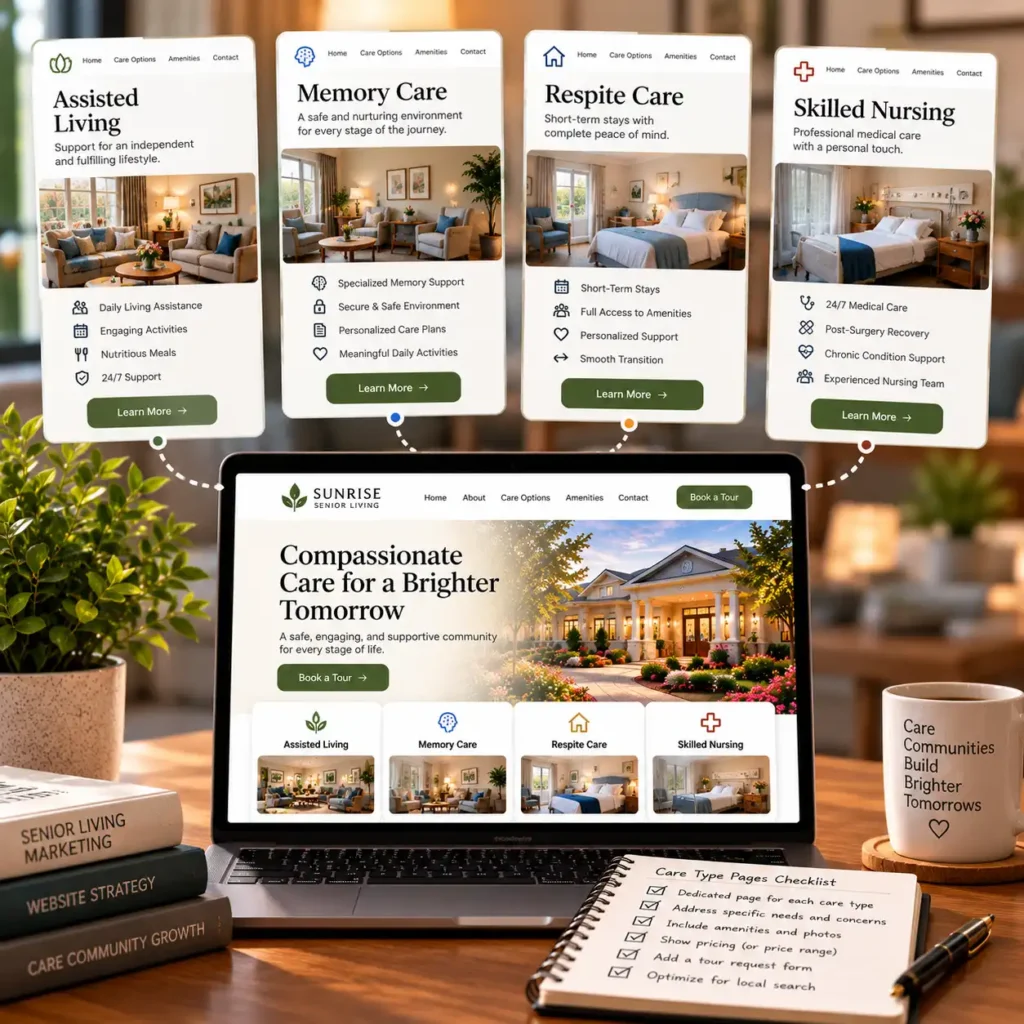
4. Build a Dedicated Page for Each Care Type You Offer
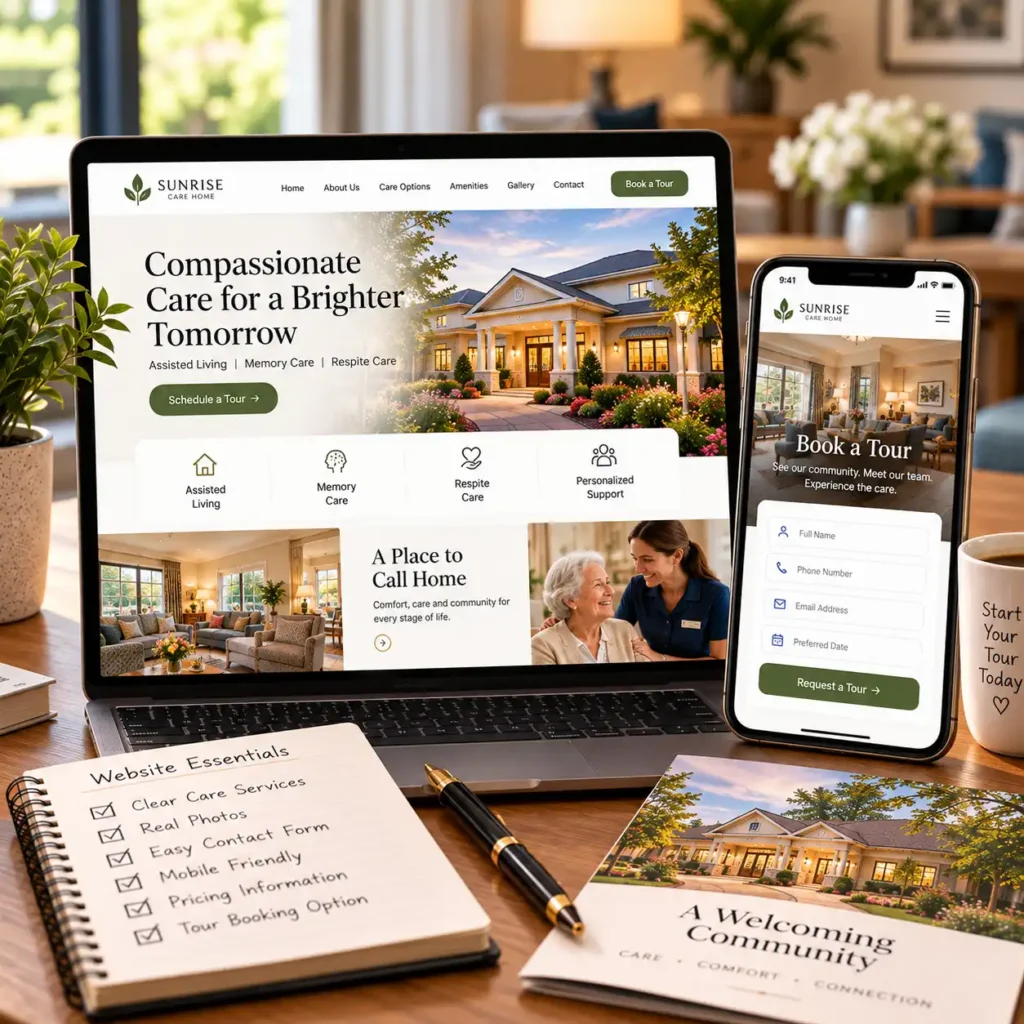
One “our services” page trying to cover assisted living, memory care, and respite in a single scroll serves none of them well. A memory care searcher is scared about a specific thing. Burying that fear under general amenities does not answer it.
Give each care type its own page. Address the fear tied to that search directly. Include a starting price range, even a wide one, since hiding pricing pushes families back to Google. Add a staff-to-resident ratio if it’s worth sharing, plus photos specific to that care type. This is where local SEO for care homes really compounds, since each page becomes its own entry point for its own search.
Cover the essentials:
- One page per care type: assisted living, memory care, skilled nursing, respite
- Address the specific fear or need tied to that care type
- Include a starting price range, even a wide one
- Link each page to a care-type-specific tour request form
5. Answer the Questions Families Are Actually Typing
Every answered question becomes a new indexed page. Enough related pages tell search engines what your site actually knows about. That’s the whole logic behind content that ranks, and it applies here too.
Think about what families actually search. Cost questions. Timing questions, like when is it time for memory care. Comparison questions, assisted living versus nursing home. Process questions about touring or moving in. Each one is a real search with real people typing it tonight.
Target these first:
- Cost and payment questions, including Medicaid and private pay
- Timing questions about when to consider a care type
- Comparison questions between care levels
- Process questions about touring, moving in, or transitioning
- Local questions specific to your city or county
A thin, generic answer ranks worse than no page at all. Google increasingly rewards depth over volume, so don’t publish a page just to check a box.
6. Fix the Technical Basics That Quietly Cap Your Rankings
Most care home sites were built years ago and never touched again technically, even as everything around them improved. Meanwhile, a large share of these searches happen on a phone, often during a stressful moment. A slow site loses that family before they read a single word.
Cover the fundamentals:
- Load time under 3 seconds on mobile
- Fully responsive design, tested on an actual phone
- HTTPS security, non-negotiable for a site collecting family contact info
- Local business schema markup so search engines read your hours and address correctly
Run your site through Google’s PageSpeed Insights once. Fix the top three flagged issues before touching anything else technical. This tip supports senior living website design decisions your team may already be considering.
7. Build Backlinks From Sources Families Already Trust
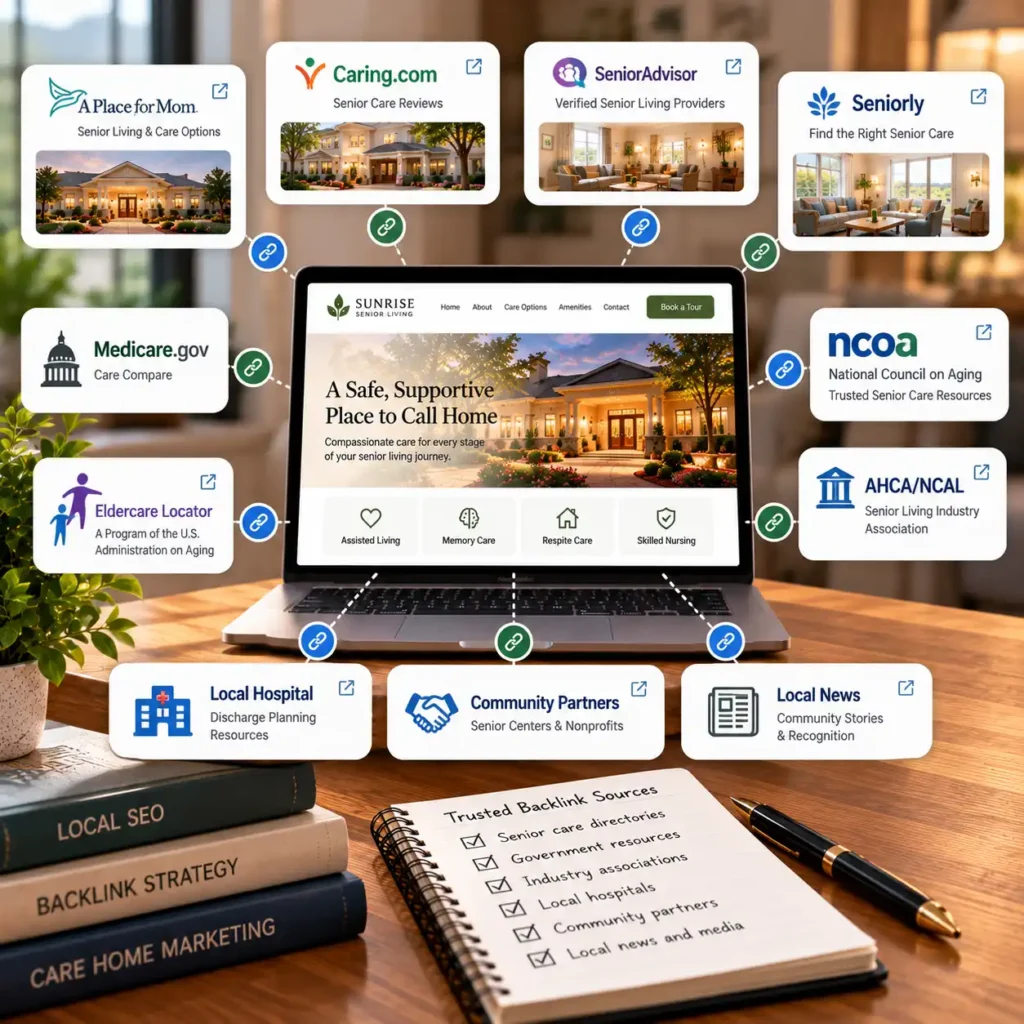
A link from a trusted local site tells search engines your care home is a real, recognized part of the community. That matters more for a small independent operator competing against a large chain’s marketing budget.
Prioritize senior care directories first, since they’re fastest to secure: A Place for Mom, Caring.com, SeniorAdvisor.com, Seniorly.com, and SeniorLiving.org. Government and nonprofit resources come next, including the Eldercare Locator, Medicare’s Care Compare, and the National Council on Aging. Industry associations like AHCA/NCAL, Argentum, LeadingAge, and NIC carry real authority too. Local hospital discharge-planning pages, senior center partnerships, and local news coverage take the longest to secure but build the most trust.
Realistic sources to start with:
- Senior care directories: A Place for Mom, Caring.com, SeniorAdvisor, Seniorly
- Government and nonprofit pages: Eldercare Locator, NCOA, local Area Agency on Aging
- Industry associations: AHCA/NCAL, Argentum, LeadingAge, NIC
- Local hospital discharge pages and community news coverage
Skip any directory or link farm outside a list like this. A cheap bulk link risks a penalty instead of a ranking boost. This tip is the slowest on the list, and the one most operators skip entirely. That’s exactly why it works for whoever bothers.
8. Optimize for How Families Search With AI Tools Now
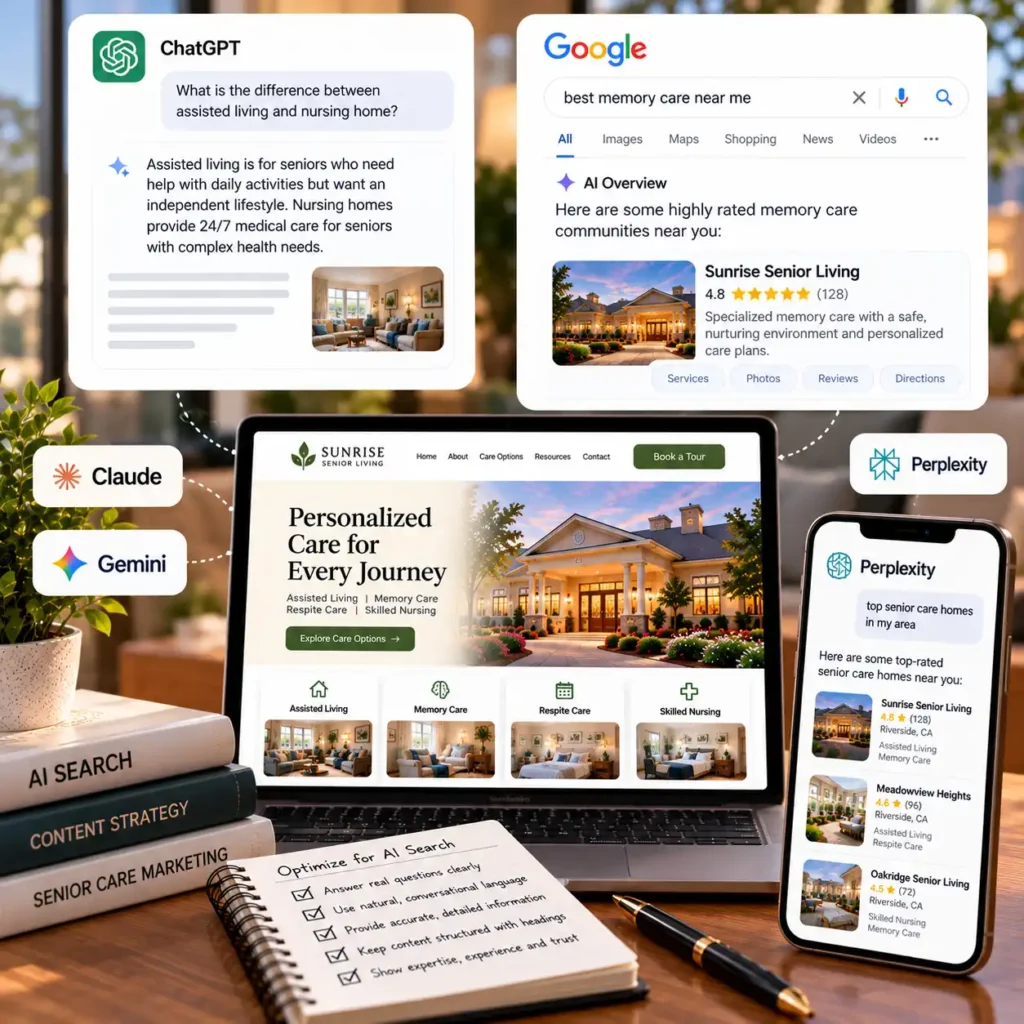
Families increasingly ask ChatGPT or Google’s AI Overviews questions like what’s the difference between assisted living and memory care near a given city. That’s a real shift, and it’s still new enough that most competitors haven’t adjusted.
These tools pull from pages that answer questions clearly and completely. Structured, direct writing tends to get summarized. Keyword-stuffed pages built purely for old-school search usually don’t. The same well-answered pages from tip five double as exactly what these tools tend to quote.
Keep it simple:
- Write direct, complete answers to real family questions
- Use headings that match how someone would actually ask
- Keep every factual claim accurate, since AI tools quote it directly
- Don’t abandon traditional SEO for this; the two overlap heavily
This isn’t a separate strategy. It’s a reason to do tip five even better.
9. Track the Numbers That Actually Predict More Move-Ins
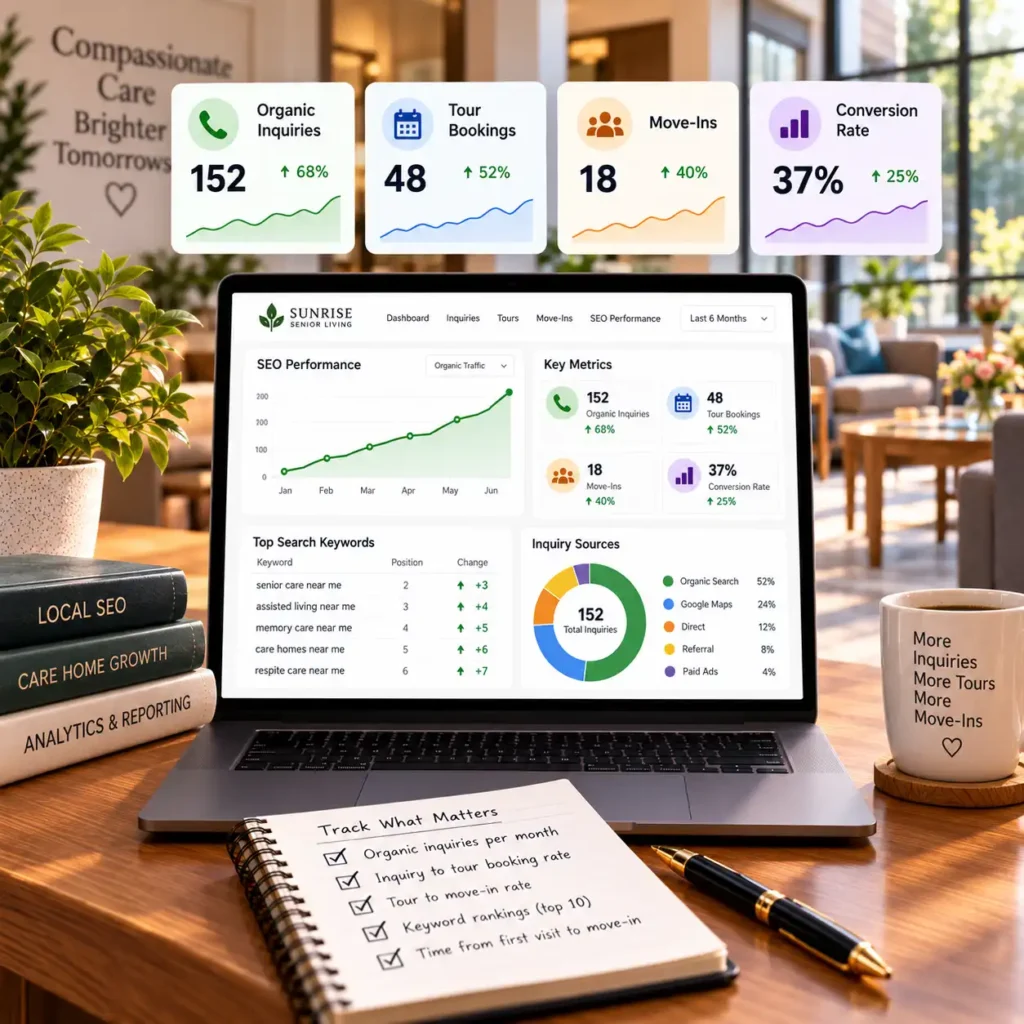
Traffic and rankings feel good to report. Neither one fills a bed by itself. What predicts move-ins is the chain underneath: inquiries, tour bookings, and the conversion rate between each step.
There’s an attribution trap specific to this industry. A family who finds you through an SEO page in March might not move in until August. Track any care home’s SEO effort over months, not weeks, or it will look like it failed when it simply hasn’t finished working yet.
Watch these five numbers:
- Organic inquiries per month, tracked by landing page
- Inquiry-to-tour booking rate
- Tour-to-move-in rate
- Keyword rankings for your top 10 target searches
- Time from first organic visit to move-in, tracked as a cohort
SUPPORTING KEYWORDS FOR THIS PIECE
| Keyword | Monthly Searches | Difficulty Level |
| home care near me | 110,000 | Low |
| companion care | 90,500 | Low |
| senior care near me | 49,500 | Low |
| personal care services | 49,500 | Low |
| in home respite care | 49,500 | Low |
| care at home | 49,500 | Low |
| respite care near me | 22,200 | Low |
| caregiver services | 22,200 | Low |
| private duty nursing | 18,100 | Low |
| respite services | 14,800 | Low |
| convalescent home | 9,900 | Low |
| home health care services near me | 8,100 | Low |
| home care services near me | 8,100 | Low |
| in home senior care near me | 5,400 | Low |
| companion care services | 5,400 | Low |
| care homes near me | 4,400 | Low |
| residential care homes | 3,600 | Low |
| skilled nursing care | 3,600 | Low |
| nursing care | 2,900 | Low |
| adult family home | 2,400 | Low |
| cost of long term care | 1,900 | Low |
| 24 hour care at home | 1,600 | Low |
| rest home | 1,300 | Low |
| average cost of nursing home | 1,300 | Low |
| average nursing home cost per month | 880 | Low |
SEO Mistakes That Quietly Undo These Tips
None of these look dramatic day-to-day. Most care home SEO fails from neglect, not from one bad decision.
- Building a great profile once, then abandoning it. Google notices inactivity.
- Writing one blog post per care type and stopping. Depth beats a single page every time.
- Copying competitor content instead of answering real questions. Families can tell.
- Ignoring mobile page speed. That’s where most of your traffic actually lives.
Let Codestro Build Your Care Home SEO Engine
Most care homes lean on the same handful of channels today. Paid ads that stop the moment budget runs dry. Referral agencies and directories that take a cut of every placement. A website nobody has touched technically since launch day. None of it compounds. Every dollar buys attention for that one month, then it’s gone.
Codestro builds the version that keeps working without ongoing spend, a team that understands senior care search behavior and the families behind every inquiry.
- Google Business Profile setup and ongoing management
- A review pipeline that brings in real, well-timed feedback
- Dedicated pages for every care type you offer
- Content that answers the exact questions families are searching for
- Technical fixes for site speed, mobile, and schema markup
- Backlink outreach to sources families already trust
Ready to stop paying for every single inquiry?
Book a free strategy call on Codestro’s Calendly, or reach out directly at info@codestro.com.
Key Takeaways
Nine tips, three speeds. Google Business Profile and reviews move fastest. Dedicated care-type pages and question-based content build the middle layer over a few months. Backlinks and AI search optimization compound over the long run, quietly, in the background.
- Google Business Profile and reviews: fastest wins, start here
- Care-type pages and content: builds steadily over months
- Technical fixes: remove hidden ceilings on everything else
- Backlinks and AI search: slow but compounding
- Tracking: none of it means anything without measuring inquiries
SEO for care homes rewards patience more than any other channel. Care homes SEO done properly outlasts every ad campaign you’ll ever run.





With increasing digital competition across the United States businesses in Washington DC, now realize that their websites need to accomplish more than just existing. Websites today need to perform, engage,
In the age of digital-first consumption, your website is an extension of your business. Whether you are a startup, small to mid-sized business, or a growing enterprise, your website can
In the fast-paced world of the cyber economy today, your website is more than just an online address — it is your most effective sales tool. Whether you are a
In today's "digital first" economy, having a website is no longer just a "nice-to-have "... it is a must-have for generating sales, establishing credibility, and growing your business! Your website
In a digitized world, your website is more than a digital business card - it is the core of your brand identity, customer engagement, and company growth. For Birmingham businesses,
Choose Your Growth Plan
Local Starter
$499/mo
- 1 City Targeting
- Google Business Profile Optimization
- 5 Citation Listings
- Monthly SEO Report
- Basic Local SEO Setup
Growth
$899/mo
- 1 City Targeting
- Google Business Profile Optimization
- 5 Citation Listings
- Monthly SEO Report
- Basic Local SEO Setup
Domination
$1,499/mo
- 1 City Targeting
- Google Business Profile Optimization
- 5 Citation Listings
- Monthly SEO Report
- Basic Local SEO Setup
Frequently Asked Questions
Care type and urgency matter more here than in most industries. Families search fear-driven terms like memory care near me, and pages need to answer that specific worry, not generic amenities.
Your Google Business Profile moves fastest, often within weeks. It’s free, and most competitors leave theirs half-finished, so a complete one stands out immediately.
Most do, at least early on. Paid ads fill the gap while SEO builds. Once organic rankings mature, many operators shift budget away from ads toward content and outreach.
Costs vary by market, but most single communities budget a modest monthly range for content, technical work, and outreach. Track cost per move-in, not cost per click, to judge if it’s working.
Yes, especially locally. Chains often neglect location-specific content and reviews. A single community that nails local SEO for care homes frequently outranks a bigger competitor in its own backyard.