Water Damage Lead Generation
6 Water Damage Lead Generation Strategies for 2026
Water damage lead generation in 2026 relies on six channels working together. Local SEO, Google Ads, Facebook Ads, social media, email, and web development. No single channel carries a restoration company alone anymore. A homeowner with a flooded basement searches Google first. They check reviews next, then call whoever answers fastest with real trust signals in place.
Most restoration companies still lean on one channel, usually paid ads or referrals. Their pipeline runs dry the moment that spend stops. This guide breaks down all six strategies for steady water damage leads in 2026. It also covers the parts most companies still get wrong. Homeowners rarely wait around for a slow response. Speed and visible trust decide who actually gets the call.
1. Local SEO for Water Damage Lead Generation
Local SEO carries more weight in this industry than any other channel. Homeowners in an active water emergency search for help right away. They don’t compare ten companies side by side. They call the first trustworthy option that shows up nearby.
That usually happens within the first minute. Google’s local map pack sits above most organic results for these searches. On mobile, it often sits above the paid ads too. That makes ranking there the single highest-leverage move for water damage lead generation. This holds in almost any competitive market.
Ranking here means visibility without paying for every click. A homeowner scanning the map pack checks star ratings fast. They tap call within seconds of finding a decent option. Falling out of that pack costs you jobs you never even see.
Your Google Business Profile is the anchor of local ranking. Most companies still leave it half-finished. It needs the right service category, real photos, and accurate hours. A steady stream of fresh reviews matters too. Add secondary categories too, for related work like mold or fire damage. In 2026, review count and recency matter for a new reason. They shape whether AI Overviews mention your business by name. A company with 300 recent reviews now outranks one with fewer.
That holds even at a slightly lower star rating. That shift is reshaping how water damage leads get won this year. Verify your listing on Google’s own platform first. Unverified profiles rank far behind verified ones. Photos should show real trucks and real crews. Skip the stock photos of a clean living room. They don’t build trust with a worried homeowner.
- Set your primary category to Water Damage Restoration Service, not a generic cleaning label
- Upload dated, real jobsite photos every week instead of stock imagery
- Keep service areas and hours accurate at all times, especially for 24/7 claims
- Request a review within 24 hours of every completed job, without exception
Google Business Profile & Review Strategy
Review generation works best as a system, not a one-off ask. Text or email every customer within a day of finishing the job. Send a second, gentler reminder five days later if they haven’t responded. Respond to every review yourself within 48 hours, good or bad.
Silence on a bad review reads worse than the review itself. Homeowners notice which companies actually engage. That builds trust before the phone even rings.
This matters beyond ranking alone. A homeowner deciding who to call during an emergency reads reviews before dialing anyone. Reviews that mention specific services carry more weight than generic five-star ratings. Basement flooding or a burst pipe, named directly, works even better. They read as proof from a real customer, not marketing copy you wrote yourself.
- Automated text request sent 24 hours after job completion
- Follow-up reminder sent at day five if there’s no response
- Owner reply on every single review within 48 hours
- Monthly check on your review count against your top three local competitors
2. Google Ads for Emergency Water Damage Searches
Google Ads gets you in front of homeowners the moment they search. It isn’t cheap in this category, though. Cost per click for emergency terms runs $50 to $90 in most metros. Water damage repair near me is a good example. That price only makes sense with a tight campaign structure behind it. Build separate ad groups for each damage type.
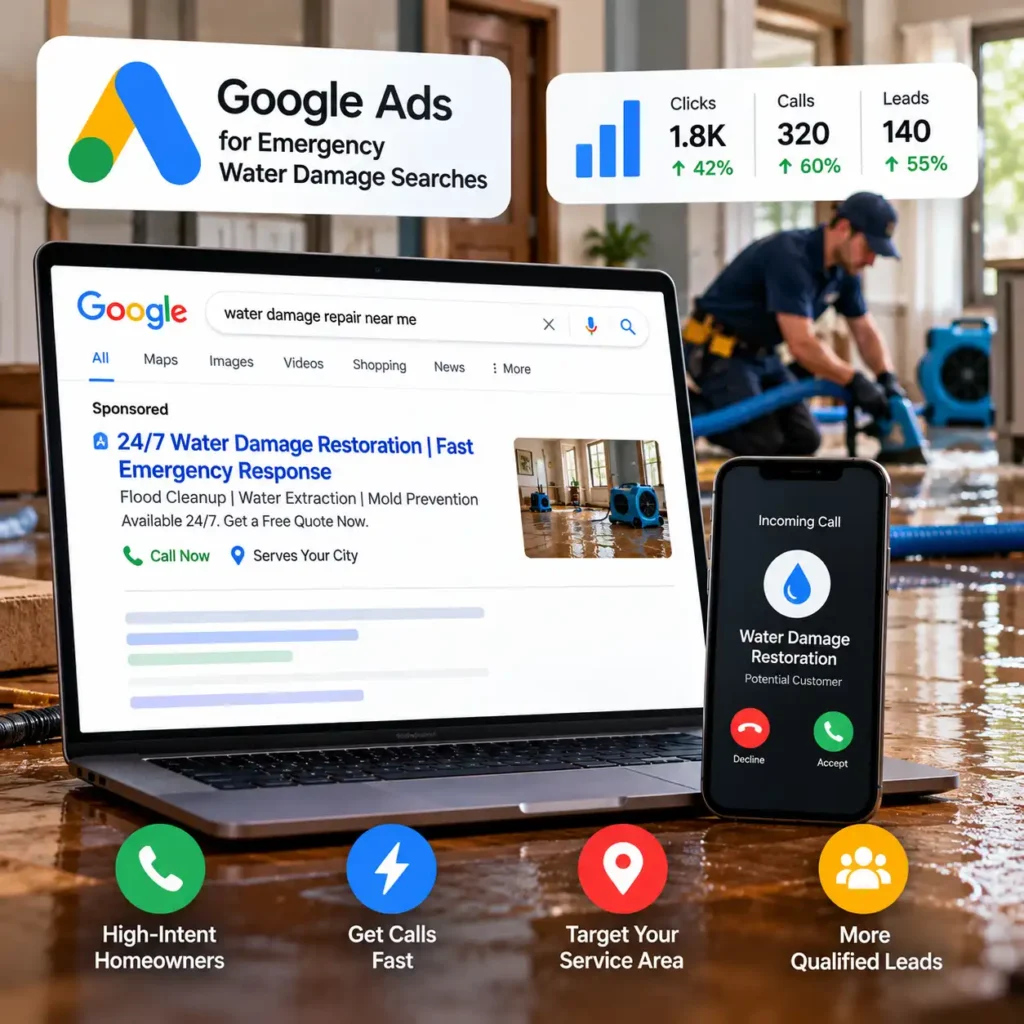
Think burst pipes, basement flooding, storm damage, sewage backup. One broad campaign wastes budget on searches that don’t match your services. Write ad copy that speaks to urgency directly. Use phrases like 24/7 emergency response or fast dispatch team. Add call extensions so your number shows on the ad itself. Set a daily budget cap per ad group.
This stops one damage type from draining the account by noon. Review your search terms weekly, and add new negative keywords as odd queries show up.
- Separate ad groups by damage type; never one generic campaign for everything
- Emergency-focused headlines: fast response, 24/7 availability, insurance claims accepted
- Call extensions with a real local number, not a call center line
- Negative keywords to filter out DIY searches and job seekers early
Even a well-built campaign fails without the right landing page. Send PPC traffic to a dedicated page, never your homepage. It needs a visible phone number and a short contact form. Before-and-after photos above the fold help too. Skip the long company history and full service list here. Someone with water spreading across their basement wants proof you can help right now. Track which ad groups actually produce calls, not just clicks.
Shift budget toward those every week. A/B test two headlines at a time, not five. Small sample sizes make results hard to trust. Keep the form short: name, phone, and address are enough to start.
3. Facebook Ads for Water Damage Leads
Facebook Ads work differently from Google Ads in this industry. Google catches people who are already searching. Facebook reaches homeowners before they’ve even thought to search. It targets based on location and life-stage signals, like a recent home purchase. Set your radius tight, usually 10 to 15 miles from your service area.
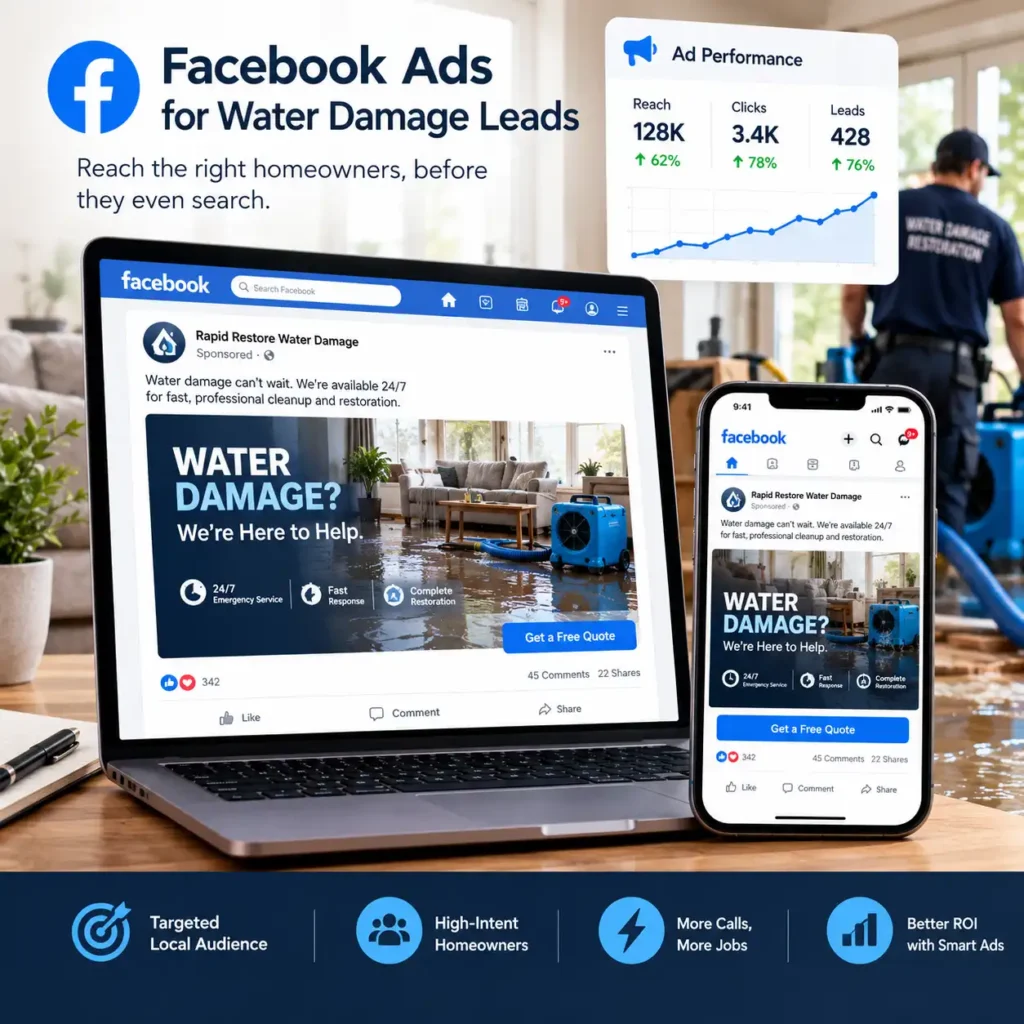
Water damage restoration leads are almost always local and time-sensitive. Wider targeting just burns budget on people who will never call. Facebook’s ad manager layers interests on top of location. Recent movers and homeowners are a good place to start. Keep the audience wide enough for the algorithm to work with.
Creative matters more here than precise targeting does. Before-and-after photos of real jobs outperform stock imagery every time. Short video walkthroughs of a restoration project build more trust than written copy ever can. Storm-response ads timed to real weather events convert well. They match exactly what the viewer already worries about that week.
One tactic almost nobody in this space uses well is retargeting. Most people leave a restoration website without calling on the first visit. A retargeting ad built around a testimonial brings a meaningful share of them back. Run three creative variations at once, not just one. Let the platform find the strongest option within a week. Refresh the creative every few weeks. The same ad shown too often starts to feel tired.
- Local radius targeting, 10 to 15 miles from your service area
- Homeowner and recent-mover audience signals over broad demographics
- Retargeting ads for website visitors who didn’t call
4. Social Media Marketing (Organic)
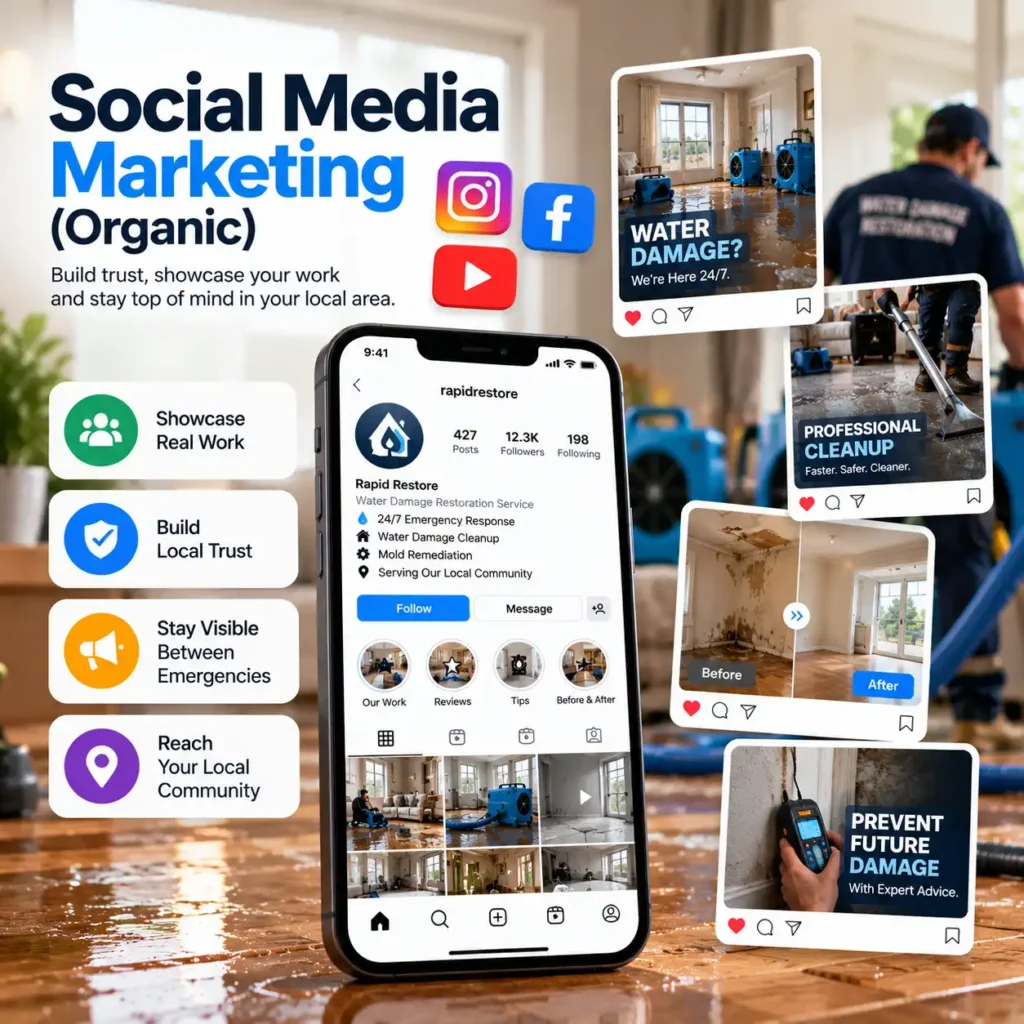
Organic social media builds trust that pays off later. It isn’t the channel that converts leads today. Post consistently on Facebook and Instagram with before-and-after project photos and seasonal maintenance tips. This keeps your business visible during the long stretches with no active emergencies nearby. When one finally happens, your name is already familiar.
Consistency matters more than polish here. A steady, plain post beats an occasional expensive one every time. Tag the neighborhood where each job happened. Local tags help your content reach people nearby. A quick video from the truck feels more real than a studio shot.
LinkedIn plays a completely different role in this mix. Use it to build relationships with insurance agents and property managers, not homeowners directly. These referral sources often send more consistent, higher-value work than any consumer platform can. A short update about a finished commercial job does more here. It beats a polished paid ad most of the time.
Comment on posts from local agents and managers regularly. That visibility compounds slowly, over many months. A quick congratulations post costs nothing and builds goodwill.
- Facebook and Instagram: before-and-after photos, seasonal tips, real customer stories
- LinkedIn: referral relationships with insurance agents and property managers over time
- Post on a fixed schedule, even if it’s only two or three times a week
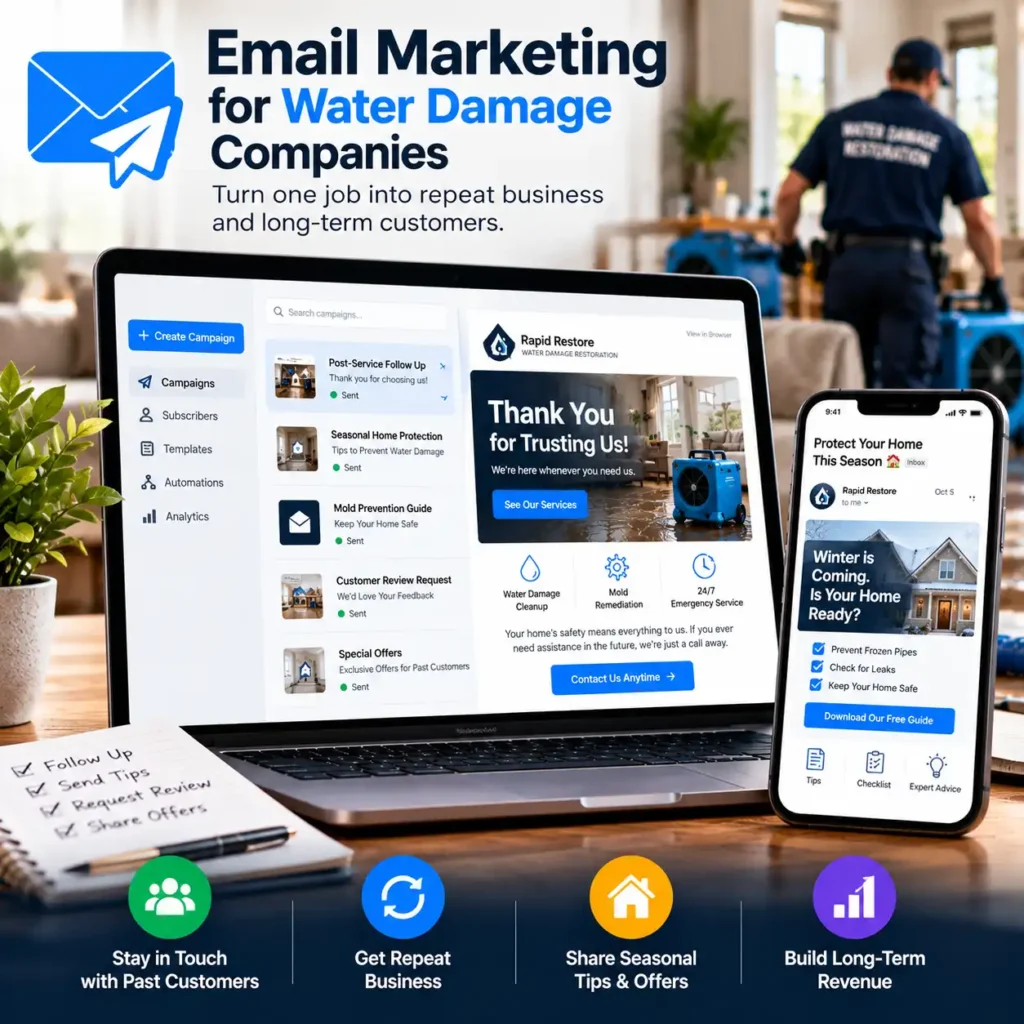
5. Email Marketing for Water Damage Companies
Email marketing isn’t built for first-touch water damage lead generation. Nobody searches Google mid-flood and signs up for a newsletter instead of calling for help. Its real value shows up after the first job. That’s when you’re earning repeat business and referrals from that same household. Capture an email address at every customer interaction you have.
A completed job, a quote request, or a simple site signup all count. A free water damage checklist works well as an offer here. It gives homeowners a reason to share their email early.
Segment your list and automate the follow-up sequences. Nothing should depend on someone remembering to send an email. Send seasonal storm-prep reminders before hurricane season hits your region. Send a follow-up two weeks after a completed job asking for a review. Send a simple check-in email a year later.
Plumbing failures tend to repeat in the same homes. None of this needs much ongoing effort once it’s set up. It just needs to keep running quietly. Keep subject lines short and specific. Generic subject lines get ignored in a busy inbox. A line like ” Storm hitting your area this week performs far better.
- Capture emails at every customer touchpoint, not only after a closed sale
- Automate seasonal storm-prep and maintenance reminder sequences ahead of storm season
- Send a review request two weeks after every job completion
- Segment your list by past service type for more relevant follow-ups
6. Web Development That Converts Emergency Traffic
Every strategy above sends traffic somewhere. That somewhere still needs to convert it. A homeowner mid-emergency needs your phone number, your service area, and proof you’re legitimate. All of that within a few seconds of landing on your site. A slow mobile site or a buried contact button costs you that traffic. It doesn’t matter how much you spent generating it. Web development for a water damage company isn’t a design exercise.
It’s a conversion problem wearing a design one’s clothes. Compress your images before uploading them. Large photo files are the top cause of a slow site. A one-second delay can cost real mobile visitors before the page even loads.
Build dedicated pages for each city and damage type you serve. This mirrors what you’d already do for local SEO. Keep the homepage itself simple. Phone number above the fold, a short form, and real project photos. Mobile speed matters more here than in almost any other industry. Most emergency searches happen on a phone in someone’s hand.
Test your site on a slow connection, not just fast office WiFi. Add a sticky call button that stays visible while scrolling. Small technical fixes like this move conversion more than a full redesign.
- Click-to-call number visible on every single page, especially on mobile
- A short quote form with three fields at most, nothing longer
- Dedicated pages confirming service areas by city and ZIP code
- Real reviews and certifications displayed close to the contact form
Let Codestro Build Your Water Damage Lead Generation System
Most restoration companies right now are stuck between paid ads, lead brokers, and word-of-mouth referrals. All three work fine until you stop paying or stop asking for them. The moment the ad budget gets cut, the calls stop coming with it. That’s not a growth strategy. It’s a treadmill that never actually moves you forward.
Codestro builds the organic version instead. A system that keeps generating water damage leads long after the initial work is done. Here’s what that looks like in practice:
- Local SEO built around your real service area and Google Business Profile
- Google Ads campaigns structured by damage type, never one generic push
- Facebook Ads and retargeting that bring back visitors who didn’t call the first time
- Organic social content that builds trust between emergencies, month after month
- Email sequences that turn one completed job into repeat and referral business
- A website built to convert emergency traffic, not just look good in a portfolio
Ready to stop renting your leads and start owning them?
Book a free strategy call on Codestro’s Calendly, or reach out directly at info@codestro.com.
Key Takeaways
- Local SEO gets you found in the map pack during active emergencies.
- Google Ads brings in high-intent traffic fast, at a real cost.
- Facebook Ads target homeowners by location before they even search.
- Social media builds trust between emergencies, not during them.
- Email marketing turns one completed job into repeat business.
- Web development converts the traffic every other channel sends you.
- Combined, these six drive steady water damage leads instead of one-off spikes.
Frequently Asked Questions
Paid leads typically cost $100 to $400 through Google Ads or lead brokers. Local SEO brings that down to $30 to $80 per lead over time. That’s once the system is fully in place. The upfront cost runs higher for SEO, but the long-term cost per lead stays lower. Exclusive leads cost more than shared ones, but they convert better.
Both, used in the right sequence. Google Ads brings in leads fast while your SEO builds up in the background. Once local rankings hold steady, most companies cut ad spend by 40 to 70 percent. Lead volume stays about the same after that cut.
Google Ads and Facebook Ads produce calls within one to two weeks of launch. Local SEO takes three to six months to show steady results. Once it ranks, it keeps working without ongoing ad spend. Facebook Ads move almost as fast, within days in some markets.
Track cost per lead, call-to-job conversion rate, and map pack ranking every week, not monthly. If those numbers improve quarter over quarter, the strategy is working. If they stay flat, the system needs a real fix, not more spend. Review these numbers with your team every single week.