Facebook Ads for Therapists
More leads. More rankings. More revenue. Built specifically for your industry
Get Your Free Consultation Today!
Results Therapists Actually can See
Facebook Ads for Therapists: 8 Tips to Get Clients
Facebook ads can generate a consistent flow of new customers to your therapy practice if you’ve got the targeting right, the offer right, and the landing page right. Most private practice owners test it once, receive a few clicks, and then give up before it has any real data to analyze. That’s the mistake. There is increasing competition from local therapists for therapy clients, and referrals on their own are not enough to fill the calendar quickly with therapy clients. Empty sessions that don’t fill are money dropping down the drain. In this guide, you’ll learn 8 of the most effective tips for setting up pixels, targeting audiences in Meta’s health rules, creating landing pages, writing ad copy, creating creatives, testing the options, budgeting, and retargeting.
Why Facebook Ads Work for Therapist Practices
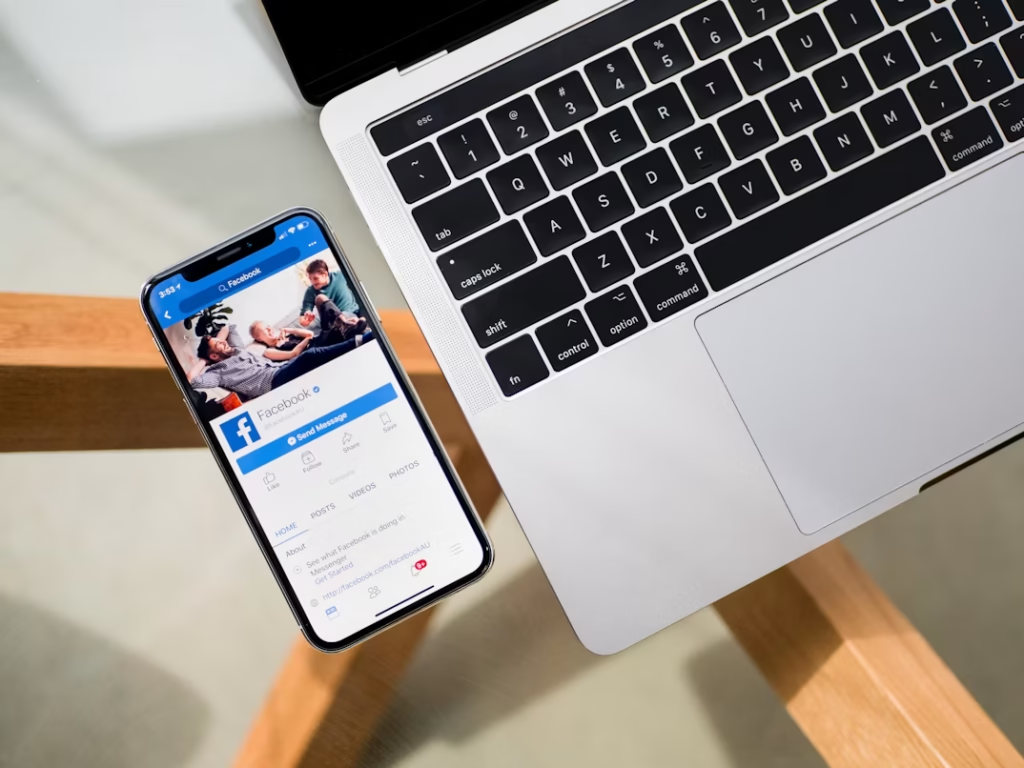
Facebook still remains the most popular social network for adults, and many adults check their Facebook before checking anything else in the morning. This is important for therapists because most people don’t actively look for a therapist every day. They’re scrolling. When people begin typing in “therapist near me” to Google, Meta ads for therapists get in front of them before they get to the bottom page of the search results. The only thing that’s different with Facebook ads for therapists and Google Ads is this. One creates awareness before the search. The other depicts the search. If it’s only service providers who refer people or Psychology Today lists it, no one who hasn’t heard of it yet will know about it.
What You Can and Can’t Target on Facebook as a Therapist
You cannot target Facebook users by mental health condition. So Meta closed the door in 2022, and it has not reopened. That one adjustment is what makes so many therapists receive an error message rather than an audience when they set up a campaign and select depression or anxiety as an interest. Facebook ads for private practice are no longer based on diagnosis but on demographics, location, and adjacent interests. It is a genuine limitation but one that can be overcome with a little knowledge. Grow your audience using these instead:
- The radius of location around the office typically is 10 to 25 miles, or the radius for telehealth can be statewide.
- Specify a more specific age range, not a wide default
- Related products like self-help reading, parenting guides, or mindfulness applications
- Stressors that trigger a person’s need to seek assistance, such as a new home, new relationship, or new baby
- Email list lookalikes that are created from existing or previous client lists.
8 Facebook Ad Tips to Get More Therapy Clients
None of the eight tips below require a marketing degree. They’re the practical steps that separate a campaign that produces consultations from one that produces likes.
Tip 1: Install Facebook Pixel Before You Spend a Dollar
Facebook Pixel is a short piece of code placed on your website that tracks what a visitor does after clicking your ad. Without it, you’re guessing at what happens after the click. With it, you know whether someone filled out the contact form, booked a call, or left without doing either. Set up conversion events on the contact page and the booking page specifically, not just the homepage. This single step also unlocks retargeting later, which is Tip 8 and one of the highest-return tactics in this list. Skipping Pixel is the most common reason a Facebook ads budget for therapists gets spent with nothing to show for it.
Tip 2: Build Your Audience Around Demographics, Not Diagnosis
Since diagnosis targeting is off the table, layering works better than guessing. Combine a tight location radius with an age range that matches your typical client, then add one or two adjacent interests. A therapist who specializes in postpartum anxiety, for example, might target women aged 25 to 40 within 20 miles who follow parenting content and recently had a life event tagged as “new child.” That’s specific enough to reach the right person without ever mentioning a condition. Facebook ads for therapists work best when the audience is narrow and the message matches that narrow group exactly.

Tip 3: Send Ad Clicks to a Dedicated Landing Page, Never Your Homepage
A homepage speaks to everyone, which means it converts almost no one from a cold ad click. Someone who clicks an ad about burnout in new parents wants a page that keeps talking about burnout in new parents, not a general bio and a list of every specialty the practice offers. Build one landing page per campaign that mirrors the exact promise made in the ad. One audience, one message, one next step. A mismatch between what the ad says and what the landing page delivers is one of the most common reasons ad spend gets wasted before it ever produces a consultation request.
Tip 4: Write Ad Copy That Leads With Feeling, Not Credentials
Most therapist Facebook ad copy reads like a directory listing. “Licensed therapist accepting new clients, specializing in CBT and EMDR” is accurate, but it doesn’t stop a scroll. Credentials answer a question nobody scrolling Facebook is asking yet.
What tends to work better sounds closer to how the person actually feels right now: describing the version of them that’s holding it together during the day and falling apart quietly at night. That kind of copy makes the reader think “that’s me” before they even notice it’s an ad. Save the modalities and licensure details for the landing page, where someone already interested will actually read them.
Tip 5: Use Real Photos and Video Over Stock Images
A polished stock photo of a smiling stranger in a blazer does not build trust the way a real, slightly imperfect photo of the actual therapist does. Therapy is a service built on trust before anything else happens, and people can tell the difference between a stock library and a real office. A short video, 30 to 60 seconds, of the therapist speaking directly to camera about who they help tends to outperform static images for building that early trust. It doesn’t need a professional crew. A phone camera and decent lighting is enough.
Tip 6: Test More Than One Ad at a Time
Running a single ad and hoping it performs is a guess dressed up as a strategy. Split testing means running two or three versions, changing one variable at a time such as the image, the headline, or the audience, then letting the data show which one gets more consultation requests for the same spend. Guessing wastes budget. Testing earns data that can be reused in the next campaign. Even a small practice with a modest budget benefits from testing two ad variations before committing spend to a single one.
Tip 7: Set a Realistic Budget and Give It Time to Work
Facebook’s algorithm needs time and data before it can find the right people efficiently. A daily budget under $10 rarely gives it enough signal to optimize. Most therapists should plan for $10 to $20 per day for at least two to four weeks before judging results, which puts a real test budget somewhere between $300 and $600. Below that, the campaign never leaves its learning phase.
- Typical cost per click: $1 to $4
- Minimum test budget: $300 to $600
- Time before results are meaningful: 30 days or roughly 50 conversion events
A single new client is often worth thousands of dollars in ongoing sessions, so a $100 to $150 cost per consultation request can still be a strong return once the math is worked out.
Tip 8: Retarget the People Who Clicked but Didn’t Book
Most people who click an ad and land on a page do not fill out the form on the first visit. That’s normal, not a failure of the ad. Pixel data lets you show a follow-up ad specifically to people who visited the landing page but didn’t complete the contact form, reminding them of the offer they were already considering. A retargeting window of about seven days tends to work well. After that point, most people who haven’t converted are unlikely to, so there’s little value in continuing to chase them past that window.
Mistakes That Waste Therapist Ad Budget on Facebook
A few habits show up again and again in campaigns that underperform, and most of them are easy to fix once they’re named.
Boosting a Facebook post instead of building a real campaign in Ads Manager, which limits targeting and optimization options
Judging results before the campaign has run for at least 30 days
Running the same ad creative for months without a refresh, which leads to ad fatigue as the same audience sees it too many times
Ignoring the landing page when clicks are strong but consultation requests are low, when the page is almost always the actual problem
Targeting too broadly out of fear that a narrow audience will run out of people to show ads to
Let Codestro Build Your Facebook Ads for Therapists
Most therapy practices are still leaning on referrals, a paid directory listing, or ad spend that stops producing the moment the budget runs out. All three work, but none of them compound. The referral dries up when the referring provider gets busy. The directory listing disappears the day the subscription lapses. The ad account goes quiet the day spend stops.
Codestro builds the version of visibility that keeps working after the campaign ends: the organic search presence, content, and local search foundation that sits underneath paid ads instead of depending on them entirely. For a practice working through the tips above, that looks like:
- Pixel and conversion tracking set up correctly from day one
- Audience targeting built around demographics and life events, not guesswork
- A dedicated landing page for every campaign instead of a homepage redirect
- Ad copy and creative that leads with how the client feels
- Retargeting sequences for the visitors who almost booked but didn’t
Ready to stop rebuilding momentum from zero every time ad spend pauses?
Book a free strategy call with Codestro →
Or reach us at info@codestro.com
Key Takeaways
Getting real results from Facebook ads for therapists comes down to a handful of decisions made correctly at the start: tracking in place, a landing page that matches the ad, and copy that speaks to how the client feels rather than what the therapist is credentialed in.
- Install Pixel before spending anything
- Build one landing page per campaign, matched exactly to the ad
- Lead ad copy with feeling, not modalities or licensure
- Budget for 30 days before judging any result
- Retarget the visitors who almost booked but didn’t
Get these five right, and Facebook ads for therapists stop being a gamble and start being a repeatable part of how the practice fills its calendar.





With increasing digital competition across the United States businesses in Washington DC, now realize that their websites need to accomplish more than just existing. Websites today need to perform, engage,
In the age of digital-first consumption, your website is an extension of your business. Whether you are a startup, small to mid-sized business, or a growing enterprise, your website can
In the fast-paced world of the cyber economy today, your website is more than just an online address — it is your most effective sales tool. Whether you are a
In today's "digital first" economy, having a website is no longer just a "nice-to-have "... it is a must-have for generating sales, establishing credibility, and growing your business! Your website
In a digitized world, your website is more than a digital business card - it is the core of your brand identity, customer engagement, and company growth. For Birmingham businesses,
Choose Your Growth Plan
Local Starter
$499/mo
- 1 City Targeting
- Google Business Profile Optimization
- 5 Citation Listings
- Monthly SEO Report
- Basic Local SEO Setup
Growth
$899/mo
- 1 City Targeting
- Google Business Profile Optimization
- 5 Citation Listings
- Monthly SEO Report
- Basic Local SEO Setup
Domination
$1,499/mo
- 1 City Targeting
- Google Business Profile Optimization
- 5 Citation Listings
- Monthly SEO Report
- Basic Local SEO Setup
Frequently Asked Questions
They can, but they run differently from Google Ads. Facebook isn’t used by people who are looking for something, so it must be a specialty, a landing page that converts, and it takes at least 30 days of testing before it will prove results.
Begin at $10 to $20 a day for 2–4 weeks, testing yourself out of the $300 to $600 realm. Any price below $10 a day will not allow the algorithm to optimize the delivery well enough to get the right people.
Allow for at least 30 days. It takes around 50 conversion events to fully optimize Meta’s algorithm, and for a therapy practice, a conversion typically is not a sale, but rather a consultation request, meaning it takes a little longer to collect.
As of 2022, No. Meta has stopped using health-condition targeting. Therapists can no longer target ads by diagnosis on Facebook—they’re targeting by location, age, adjacent interests, and life events instead.
Google Ads are typically more effective in converting, since they are attracting those seeking assistance. Facebook ads are great for creating awareness among people who are not searching, complements well when Google campaigns are going on.